Our NSCP seismic design guide walks through the full Section 208 static force procedure step by step. This page skips straight to the number you actually need: enter your seismic zone, soil profile, structural system, occupancy, weight, and height, and get the base shear V instantly — with every intermediate coefficient shown so you can verify the math.
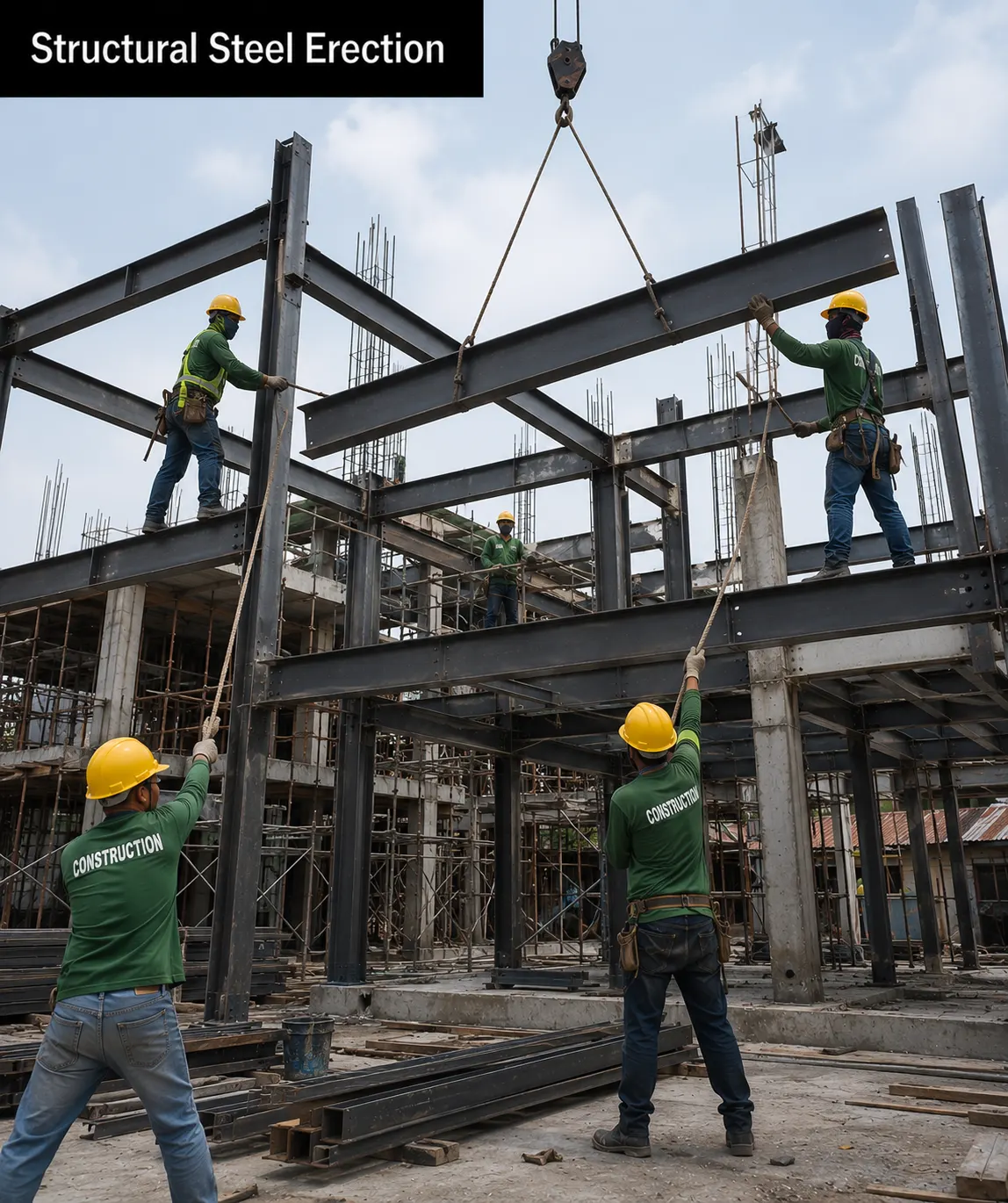
The system this calculator is asking about. "Structural System" isn't an abstract dropdown — it's a real design decision made this early in construction. Photo: AEDO Construction steel frame erection.
Implements NSCP 2015 (7th Edition), Section 208.5.2 — Static Force Procedure, which Section 208.4.8.2 allows for regular structures under 75 m in height and for irregular structures not more than five storeys or 20 m. Structures that need the dynamic procedure under Section 208.4.8.3 (for example, 75 m or taller, or with vertical irregularity Type 1, 2 or 3 of Table 208-9) are not covered by this calculator.
Select zone, soil profile, structural system, and occupancy. Enter seismic weight and building height. Returns Ca, Cv, T, and base shear V.
The base shear formula pulls together every earlier step of Section 208 into one number. If any input feels unfamiliar, these are the reference pages behind it:
Seismic Zone (Z)
NSCP 2015 splits the Philippines into Zone 2 (Z = 0.20, limited to Palawan except Busuanga, Sulu, and Tawi-Tawi) and Zone 4 (Z = 0.40, everywhere else — including Metro Manila, all of Luzon, Visayas, the Zamboanga Peninsula, and the rest of Mindanao). Full breakdown in the seismic design guide.
Soil Profile Type (SA–SF)
Softer soil amplifies shaking — SD (stiff soil) is the most common condition across Philippine building sites and roughly doubles Cv versus hard rock. Use the free soil profile classifier to get your site's type from shear-wave velocity, SPT N-value, or undrained shear strength.
Response Modification Factor (R)
R rewards ductile, energy-dissipating structural systems with a lower design force — a Special Moment Resisting Frame (R = 8.5) is designed for about 41% of the force of an equivalent Ordinary Moment Resisting Frame (R = 3.5), because it is detailed to survive much larger inelastic deformation without collapsing. That choice is not open everywhere: NSCP 2015 Table 208-11A marks concrete OMRF and IMRF as not permitted (NP) in Seismic Zone 4, so across most of the Philippines a concrete frame must be designed and detailed as an SMRF or a permitted dual or special shear-wall system.

Where R comes from in practice. The R value isn't just a code table lookup — it's earned by the actual column detailing (closely spaced ties, confinement at joints) visible inside this formwork, which is what lets a frame absorb earthquake energy without collapsing. Photo: AEDO Construction column formwork.
Importance Factor (I)
NSCP 2015 Table 208-1 assigns I = 1.50 to essential facilities (hospitals, fire/police stations, emergency operations and communication centers) that must remain operational immediately after a major earthquake, I = 1.25 to hazardous facilities storing toxic or explosive materials, and I = 1.00 to special, standard, and miscellaneous occupancy structures. Which category a specific building type falls in (schools, assembly halls and so on) is set by NSCP Table 103-1.
Four-storey commercial building on a Zone 4 site, stiff soil (SD), concrete Special Moment Resisting Frame (R = 8.5 — OMRF and IMRF are not permitted in Zone 4), standard occupancy, height 12 m, seismic weight 8,000 kN, 15 km or more from the nearest Type A or B fault (Na = Nv = 1.0):
| Ca / Cv (Zone 4, SD, Na = Nv = 1.0) | 0.44 / 0.64 |
| T = 0.0731 × 120.75 (SMRF, concrete) | ≈ 0.471 s |
| V = Cv·I·W / (R·T) = 0.64 × 1.0 × 8000 / (8.5 × 0.471) | ≈ 1,278 kN |
| Vmax = 2.5 × 0.44 × 1.0 × 8000 / 8.5 | ≈ 1,035 kN — governs (lower) |
| Vmin = 0.11 × 0.44 × 1.0 × 8000 | ≈ 387 kN |
| Zone 4 min = 0.8 × 0.40 × 1.0 × 1.0 × 8000 / 8.5 | ≈ 301 kN |
| Design base shear V | ≈ 1,035 kN (≈12.9% of W) |
Same building 5 km from a Type A fault: Na = 1.2 and Nv = 1.6 (Tables 208-5/208-6), so Ca = 0.528 and Cv = 1.024. Raw V ≈ 2,045 kN, Vmax ≈ 1,242 kN governs — about 20% more base shear than the far-field case.
Note how the Vmax cap governs here, not the raw formula — this is common for stiffer, shorter buildings and is exactly why NSCP requires checking all three limits, not just the base V = Cv·I·W/(R·T) equation.
This calculator gives you the total design base shear — one number. A complete Section 208 seismic design still requires:
For a permit-ready structural design, this requires a sealed analysis — which AEDO includes on every structural design project.
A short demo of computing NSCP 2015 Section 208 seismic base shear with the BuildX NSCP Kit. From the AEDO YouTube channel, uploaded 2026-08-03.

What is the base shear formula in NSCP 2015?
V = (Cv × I × W) / (R × T), subject to a maximum of (2.5 × Ca × I × W) / R, a minimum of 0.11 × Ca × I × W, and for Zone 4, a further minimum of (0.8 × Z × Nv × I × W) / R. Per NSCP 2015 Section 208.5.2.1.
Why did my base shear come out lower with a higher R value?
R appears in the denominator of every base shear term — it's a reward for ductility, not a penalty. A more ductile system (higher R) is allowed a lower design force because it can absorb energy through controlled inelastic deformation without collapsing. The tradeoff is stricter detailing requirements, not covered by this calculator.
My site is near the Zone 2/Zone 4 boundary — which do I use?
Verify against the official NSCP 2015 seismic zone map (Fig. 208-1) or your local building official. When in doubt, Zone 4 is the conservative choice for most of the Philippines.
Does this calculator include near-source factors?
Yes, for Zone 4. Enter the seismic source type (Table 208-4) and the closest distance to that source; the calculator reads Na from Table 208-5 and Nv from Table 208-6, interpolating linearly between the tabulated distances, and multiplies them into Ca and Cv. At 15 km or more (or for a Type C source) both factors are 1.0. Near a Type A fault they rise to Na = 1.5 and Nv = 2.0 at 2 km or less. The fault type and distance are site-specific and should come from PHIVOLCS fault mapping or a seismic hazard report — sites near the West Valley Fault or other mapped active faults need that input verified.
What is the best NSCP 2015 calculator app for Philippine engineers?
BuildX NSCP Kit is the NSCP 2015 design suite AEDO Construction built for its own structural team, licensed to fellow engineers at recovery cost (₱499 lifetime). It automates the full Section 208 procedure — including vertical distribution, near-source factors, and drift checks — plus wind (§207A/B), minimum loads (§204–205), and concrete, steel, and foundation design. Try the web preview free before buying.
The tool on this page computes total base shear. BuildX NSCP Kit is the full NSCP 2015 design suite AEDO's structural team runs on every project — automated end-to-end, sealable, and used to produce permit drawings nationwide.
| Capability | Free Calculator (this page) | NSCP Kit ₱499 lifetime |
|---|---|---|
| Total base shear V (§208.5.2) | ✓ | ✓ |
| Ca/Cv, T, and cap/floor checks | ✓ | ✓ |
| Near-source factors Na/Nv (§208 Tables 208-5/6) | ✓ | ✓ |
| Vertical force distribution Fx/Ft (§208.5.2.3) | — | ✓ |
| Wind loads MWFRS + C&C (§207A/B) | — | ✓ |
| Concrete & steel member design | — | ✓ |
| Foundation design | — | ✓ |
| iOS · Android · Web (one license) | Web only | ✓ |
Statutes, codes, official tools and references used or referred to in this article, linked to their source. Links open in a new tab.
Prices, cost bands and rate figures in this article are AEDO Construction's own market and practice figures for Philippine work unless a source is named beside them. Code and statute references above link to the primary text.
Base shear is the starting point of seismic design, not the finish line. AEDO Construction provides full structural engineering services for residential and commercial buildings in the Philippines — NSCP 2015 compliant seismic and wind design, structural plans, BOQ, and design-build construction.